The launching trolley is the first and last crew member of every sail: it takes the catamaran down to the water, brings it back up the beach and carries it all winter long. A good trolley is easy to handle, looks after your hulls and lasts for years. We make our catamaran trolleys in our own workshops; here are the criteria we go through with you to choose the right model.
The size of the boat first determines where the wheels go:
Next, the width of the trolley must match the spacing of your hulls, so that the supports sit right under the hulls and not beside them. Our 4-wheel aluminium trolleys come, for example, in 2000, 2200, 2350 and 2500 mm widths. If in doubt, tell us your catamaran model and we will point you to the right width.
Aluminium is light: the trolley is easy to push, dismantle and store, which matters when you launch on your own. Galvanised steel is heavier but very sturdy, and it shrugs off the repeated handling of a club fleet.
| Aluminium | Galvanised steel | Reinforced aluminium | |
|---|---|---|---|
| Key strength | Lightness and manoeuvrability | Sturdiness | Lightness and rigidity |
| Weight | Light | Heavier | Light |
| Rigidity | Good | Very good | Very good, thanks to the internal wall in the tubes |
| Corrosion resistance | Excellent | Excellent | Excellent |
| Best for | Private owners, single-handed handling | Clubs, intensive use | Large catamarans, sandy beaches |
As for corrosion, no need to worry: both stand up perfectly to seawater. Galvanised steel is coated with a layer of zinc that sacrifices itself to protect the steel; aluminium protects itself with a thin oxide layer that re-forms as soon as it is scratched.
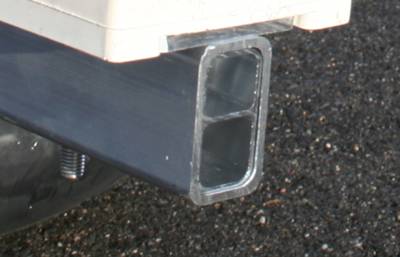
Our reinforced aluminium tubes have an internal wall that significantly increases their rigidity. The result: the lightness of aluminium with strength close to that of steel. It is the basis of our balloon-wheel trolley for large catamarans.
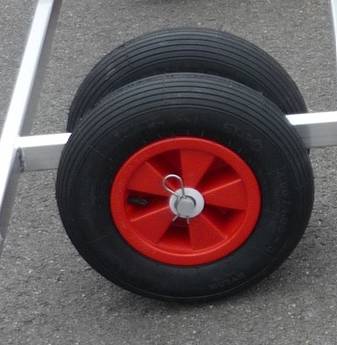
400 mm wheels: simplicity. Standard pneumatic wheels, easy to maintain and replace. They roll very well on hard ground, grass and firm sand. They are fitted in pairs on small catamarans and in sets of four on larger ones.
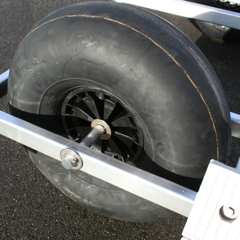
Balloon wheels: manoeuvrability. Wide and inflated to a very low pressure, they spread the weight over a large surface and don’t sink into soft sand. On a beach, you feel the difference from the very first metres: two balloon wheels are enough to carry a large catamaran. Stick to the pressure shown on the side of the tyre: over-inflated, a balloon wheel loses all its advantage on sand.
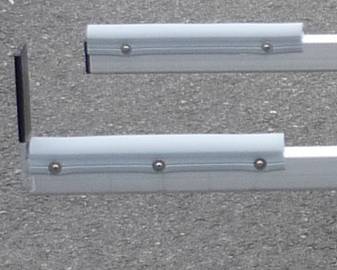
Foam strips: simplicity. A strip of foam screwed directly onto the trolley frame. The hulls rest on the foam, not on the metal. Simple, effective and economical.
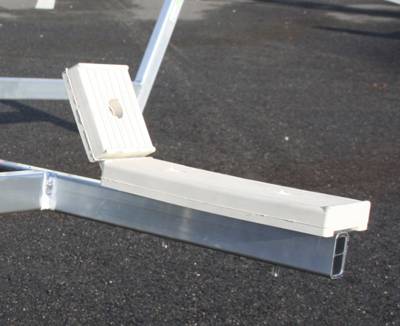
Pads: the best protection. Pivoting pads adjust to the shape of the hull and spread the load better. The hull also slides more easily over them, which makes loading and unloading the boat simpler.
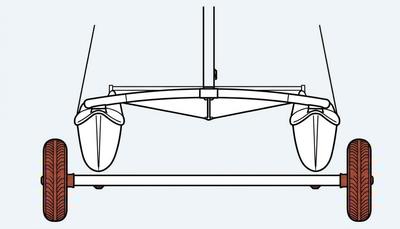
Wheels outside the hulls. Small catamarans: 10 ft and most 12 ft.
Aluminium
Light and easy to handle
WHEELS
2 × 400 mm wheels
PROTECTION
Foam strips
Galvanised steel
Sturdy
WHEELS
2 × 400 mm wheels
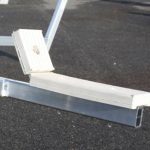
PROTECTION
Pads
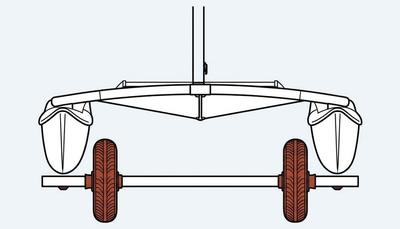
Wheels inside the hulls, for a smaller footprint. Medium and large catamarans.
Aluminium
Light and easy to handle
WHEELS
4 × 400 mm wheels
PROTECTION
Foam strips
Galvanised steel
Sturdy
WHEELS
4 × 400 mm wheels
PROTECTION
Pads
Reinforced aluminium
Light and rigid
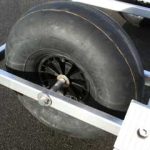
WHEELS
2 balloon wheels
PROTECTION
Pads
400 mm wheels: hard ground, grass, firm sand. Balloon wheels: soft sand, they don’t sink. Foam strips: screwed-on foam, simple and economical. Pads: pivoting, the best protection.
Find all models in our catamaran trolleys section, along with aluminium or galvanised steel drawbars for towing the trolley.
Rinse the trolley with fresh water after every sail at sea, paying particular attention to the wheel axles and the fittings. Check the tyre pressure and the tightness of the screws regularly, and replace the foam strips or pads as soon as they are worn: they are what protects your hulls.
THE NENUPHAR TIP
Our trolleys are made in France, in our own workshops. No model for your catamaran in the catalogue, or unusual hulls? We make the trolley to measure: send us your boat model and measurements at info@nenuphar.com.
It depends on the spacing of your hulls: the supports must sit under the hulls. Our 4-wheel aluminium trolleys come in 2000, 2200, 2350 and 2500 mm widths, among others. Tell us your boat model and we will confirm the right width.
400 mm wheels are fine on hard ground, grass or a slipway. If you launch from a beach with soft sand, balloon wheels make a real difference: they don’t sink and the trolley stays easy to push.
No: both are highly corrosion-resistant, steel thanks to its zinc coating and aluminium thanks to its natural oxide layer. Rinsing with fresh water after every sail at sea extends the life of the axles, bearings and fittings.
Yes. If there is no trolley for your catamaran in the catalogue, we make one to measure in our workshops. Send us your boat model or measurements at info@nenuphar.com.
Have a question about the trolley for your catamaran? Our team is here to help.